The whole yacht for your group, with an instructor aboard. The cruise counts as sea time.
This is the best option for a group of friends with sailing experience who want to practise and sharpen their skills during the cruise. A cruise like this counts as sea time for crew and/or skipper.
Passengers board from four in the afternoon on Saturday.
The Instructor comes on duty at eight the next morning, meets the passengers and runs a proper briefing.
That same day or the next, the boat sets off on the planned cruise. The Instructor chooses the route according to the experience and the preferences of the passengers. The decisive factor, though, is the weather — the direction and strength of the wind and of the waves.
On a private cruise with an instructor we work through the standard training tasks, the same as on a sea time cruise, and/or practise particular skills the crew asks for. Watches are stood aboard by day and by night.
Most days we are on passage between destinations. We spend the nights at anchor, in a port or under way. Where it is possible, we go ashore for a few hours. To rest, to do some shopping or to eat in a restaurant. One or two days we spend without moving, and that time goes to training and to rest.
You can read the list of tasks planned for the sea time cruise.
The journey ends in our home port on Tenerife, in Las Galletas. We report into the port before midnight. The next day the passengers leave the boat by twelve noon, so that she can be made ready for the next cruise.
More detail and answers to the most common questions are below.
Three cabins for 6 people. The cruise counts as sea time for crew and/or skipper.
Saturday to Saturday. Accommodation on the yacht for the whole cruise.
The price includes 40 litres, which is 10 hours of engine time.
A dinghy with a 6 hp outboard and a SUP board aboard.
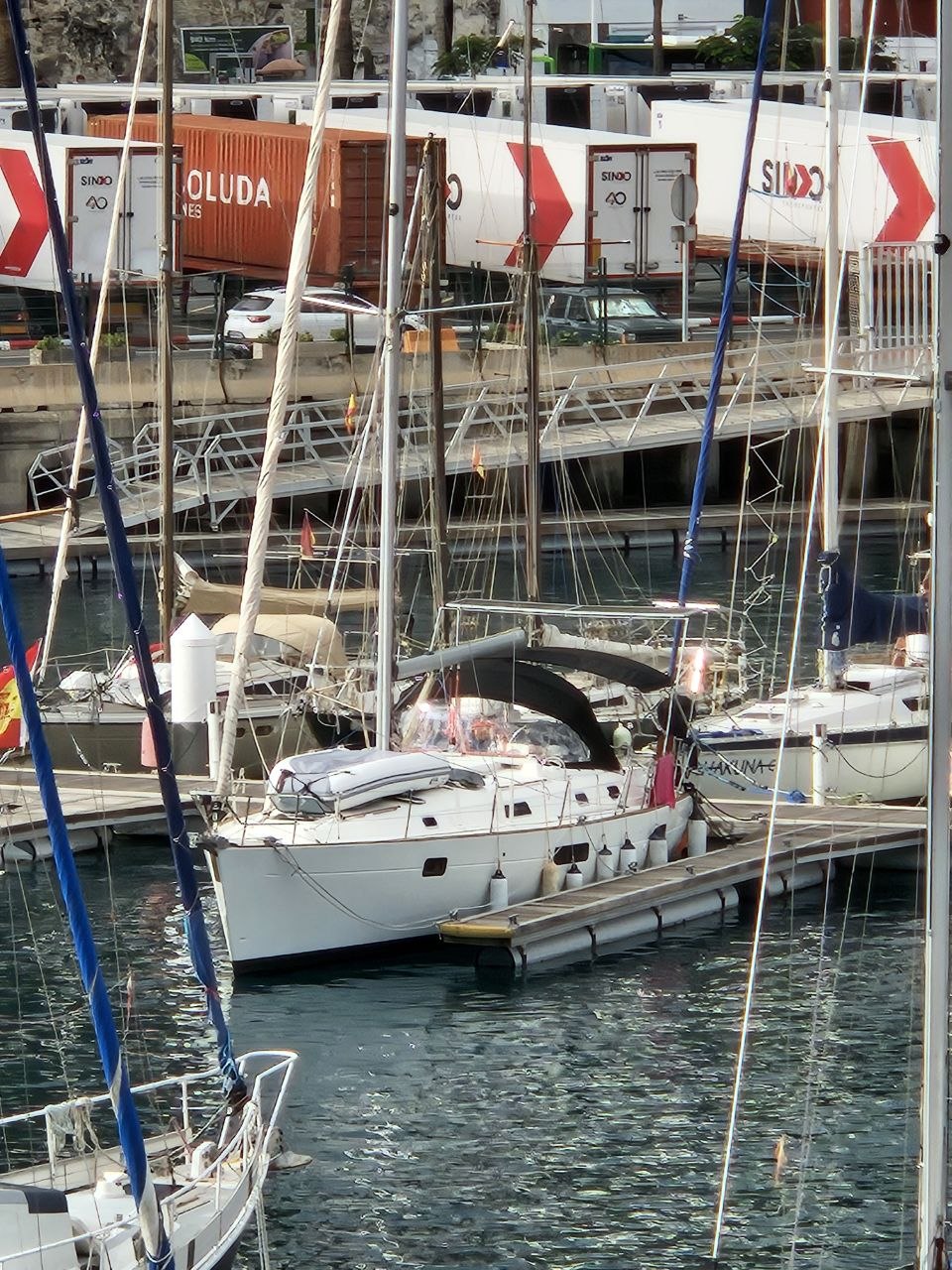
Our club sails the iconic Beneteau Oceanis 411 Clipper. Freshly refitted and well equipped with modern gear for ocean sailing. Comfortable for the crew and able to take on any conditions.
Sloop rig with a genoa. The main propulsion is a 55 hp Volvo Penta engine. She can take 10 passengers aboard. Four double cabins, a convertible bed in the saloon, two heads with a shower, and a gas cooker with an oven.
Chart plotter for navigation, radar, AIS, VHF and autopilot. On top of that, a dinghy with a 6 hp outboard and a SUP.
Read the rules before you decide on a booking.
Beginner sailors should understand and accept that a sailing cruise is an expedition and an adventure, and that it brings plenty of surprises — most of them good, sometimes not. Just as on a trip of several days into the mountains or the forest, we depend on things outside our control and on the other members of the expedition. Put your own effort into the cruise, and take the unexpected in good spirit.
Passengers arrange their own transport from the airport. Under Spanish law, only taxi companies and buses may carry passengers. UBER does not operate on Tenerife. A taxi from the southern airport, Tenerife SUR, costs around 50 euros. Bus number 415 takes 30 minutes. The northern airport is 1 hour 20 minutes away by car.
Traditionally, passengers provide their own food on board. The yacht has a gas cooker and an oven. Nominated people or volunteers cook for the group. To begin with, each passenger puts 60 euros into the boat budget. We order a delivery to the boat with a set of basic groceries, enough for several breakfasts, dinners and snacks.
If that arrangement suits the crew, they carry the boat budget on themselves from then on, overseen by the Captain. Many crews choose to eat their main meals in restaurants, so a basic budget is enough. Anyone on a special diet, or who would rather not join the shared cooking and meals, does not join the boat budget and shops for themselves. Personal treats, snacks and alcohol are everyone's own business. Looking after the Captain together is a pleasant unwritten rule.
A cruise has no fixed route, no fixed crew and no guaranteed weather, so extra costs can come up and are shared between everyone on board. The crew buys the food. Port fees are split between the crew and run between 30 and 45 euros a night.
On a sailing cruise, heavy use of the engine burns a lot of fuel. The price includes 40 litres, which is 10 hours of engine time. Beyond that, an hour costs 6.50 euros. If anything on the boat is damaged during the cruise, the person at fault or the whole group covers it.
The Captain is wholly responsible for the plan of the cruise. They gather the views and the preferences of the passengers, but many things bear on the decision, safety above all. They read the weather forecasts and judge what the crew is capable of. They may therefore decide differently from what you expect. Those decisions are to be accepted and respected.
We choose Captains in our club for their cheerful disposition. A captain is nevertheless in command: their orders are to be carried out at once and without unnecessary questions, and their decisions are to be respected even when they seem hard to understand. It is for your safety.
The Captain and the skipper on watch are responsible for the safety of the passengers and of the vessel. The Captain is answerable in law for those decisions, under threat of criminal liability — and so is anyone who fails to carry out their orders. The Captain should have time to rest as often as possible, because they have to be ready around the clock to run the boat and the crew. Sometimes the Captain is the only person aboard who can take the helm, so time on watch is limited and passages cannot be long.
Weather is the greatest variable and the greatest nuisance in sailing. It can be glorious, or it can make the trip impossible altogether. Strong wind and big seas are the plague. For reasons of safety a cruise may be cut short or called off. The club is not at fault and bears no responsibility for the weather, and makes no refund on that ground. The rules say that a departure must not be planned if difficult weather of Beaufort force 6 or above is expected (over 20 knots and/or 3 m waves).
An attack of illness can take a participant out of the cruise. They may be put off the boat at the Captain's decision, even on an island we are visiting. If you have a chronic illness you must tell the Captain and be ready for it to return. Seasickness is a nuisance but rarely dangerous. If you are seasick, tell the Captain at once.
You can cancel a cruise booking without losing your deposit up to 60 days beforehand. All outstanding payment is due in cash on the day you arrive. If the cruise is called off through the club's fault — a breakdown that makes it unsafe to sail, or no Captain — the club refunds your money.
Where the weather exceeds Beaufort force 5, the club makes no refund (the club will help the group arrange something else). Where a breakdown arises from use of the boat, a complaints procedure can be started, not a refund (processed within 14 days).
By making a booking you accept the conditions and the risks of a sailing cruise set out above.
Fill in the form and we'll reply within 24 hours with dates, availability and everything you need to know.
 Good Skipper